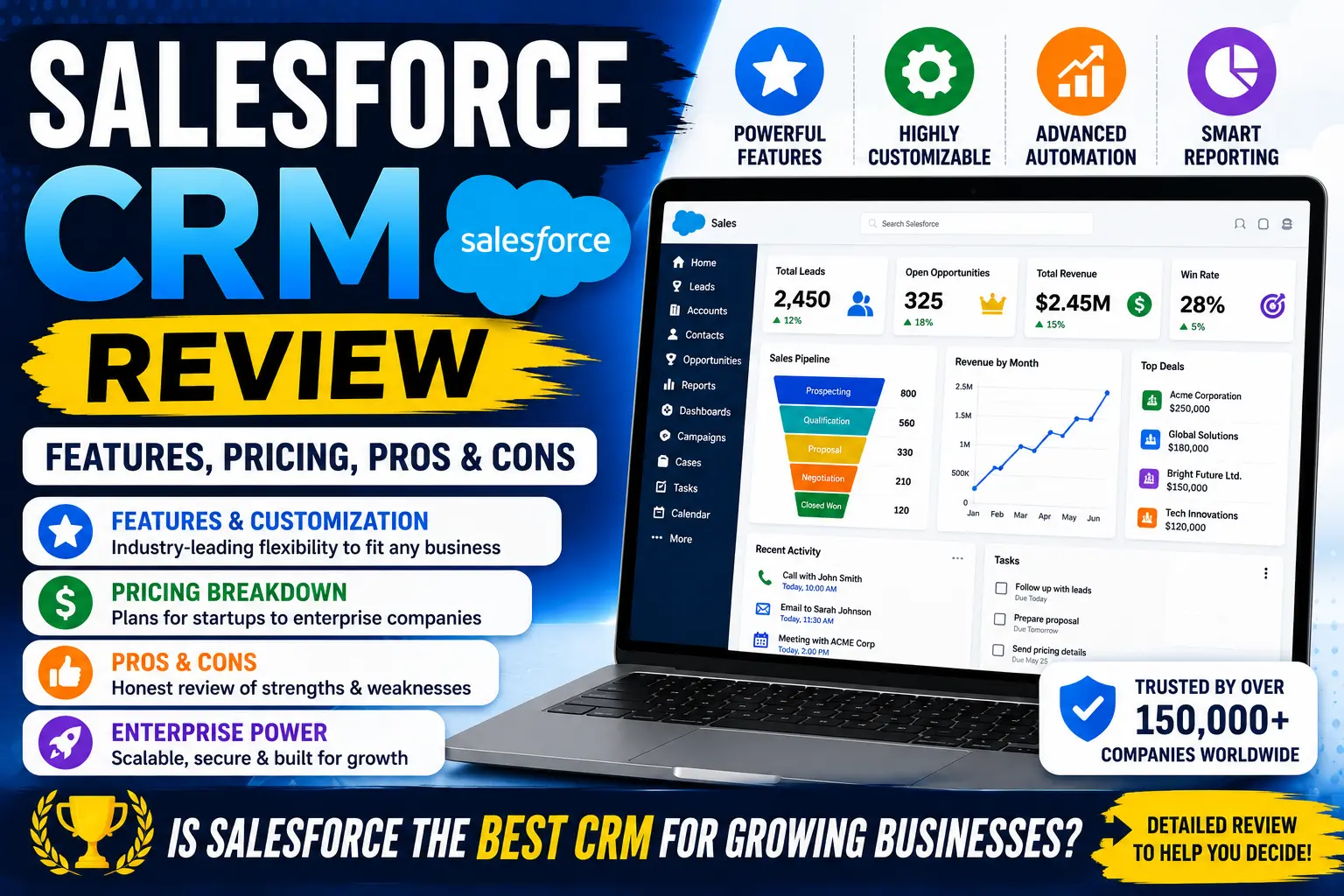
When discussing CRM software, one name consistently appears at the top of the conversation: Salesforce.
Salesforce is one of the most recognized CRM platforms in the world and is used by businesses ranging from startups to multinational corporations.
Known for its powerful features, extensive customization options, and enterprise-level capabilities, Salesforce has become the CRM of choice for many large organizations.
But does that mean it’s the right CRM for your business?
In this review, we’ll explore Salesforce CRM’s features, pricing, strengths, weaknesses, and ideal use cases to help you decide whether it’s worth the investment.
What Is Salesforce CRM?
Salesforce is a cloud-based Customer Relationship Management (CRM) platform designed to help businesses manage customer relationships, sales processes, marketing campaigns, and customer support activities.
Unlike simpler CRM solutions, Salesforce offers a highly customizable ecosystem that can be tailored to the specific needs of almost any business.
Organizations use Salesforce to:
- Track leads
- Manage sales opportunities
- Automate workflows
- Improve customer service
- Generate business insights
- Increase productivity
Today, Salesforce serves companies across nearly every industry.
Quick Overview
| Category | Rating |
|---|---|
| Features | 10/10 |
| Customization | 10/10 |
| Automation | 9.5/10 |
| Reporting | 10/10 |
| Ease of Use | 7.5/10 |
| Value for Money | 8/10 |
| Overall Rating | 9/10 |
Key Features of Salesforce CRM
Salesforce is known for its extensive feature set.
Let’s examine some of its most important capabilities.
Lead Management
Salesforce provides powerful lead management tools.
Businesses can:
- Capture leads
- Score leads
- Assign leads automatically
- Track lead progression
Sales teams gain complete visibility into every opportunity.
Opportunity Management
Opportunity management helps businesses monitor deals throughout the sales process.
Users can track:
- Deal value
- Expected close dates
- Sales stages
- Revenue forecasts
This helps organizations improve forecasting accuracy.
Sales Pipeline Management
Salesforce offers highly customizable sales pipelines.
Businesses can create workflows that match their unique sales processes.
Benefits include:
- Better visibility
- Improved forecasting
- Faster deal progression
Workflow Automation
Automation is one of Salesforce’s strongest features.
Organizations can automate:
- Lead assignments
- Follow-up tasks
- Approval processes
- Notifications
- Sales workflows
Automation reduces manual work and increases efficiency.
Reporting and Analytics
Salesforce excels in reporting capabilities.
Users can generate:
- Sales reports
- Revenue forecasts
- Performance dashboards
- Conversion reports
- Custom analytics
Managers gain valuable insights into business performance.
Customer Service Tools
Salesforce includes customer support functionality through its Service Cloud products.
Support teams can manage:
- Cases
- Tickets
- Customer communications
- Knowledge bases
This creates a better customer experience.
User Experience
Salesforce offers tremendous flexibility, but that flexibility comes with complexity.
New users often find Salesforce more difficult to learn than beginner-friendly CRM platforms.
However, once teams become familiar with the system, the platform becomes extremely powerful.
For organizations with dedicated sales operations teams, Salesforce’s learning curve is often worth the effort.
Salesforce CRM Pricing
Salesforce offers multiple pricing tiers.
Plans typically vary based on:
- User count
- Features
- Automation capabilities
- Reporting functionality
Entry-Level Plans
Designed for:
- Small businesses
- Growing teams
These plans provide core CRM functionality.
Mid-Level Plans
Include:
- Advanced automation
- Enhanced reporting
- Additional integrations
Suitable for expanding organizations.
Enterprise Plans
Enterprise subscriptions provide:
- Extensive customization
- Advanced security
- AI capabilities
- Complex workflows
These plans are designed for larger businesses.
Pros of Salesforce CRM
Industry-Leading Customization
Few CRM platforms offer the level of customization available in Salesforce.
Businesses can adapt workflows, dashboards, and processes to fit their needs.
Powerful Reporting
Salesforce provides some of the best analytics and reporting tools in the CRM market.
Excellent Scalability
The platform can support:
- Small businesses
- Mid-sized organizations
- Global enterprises
This makes Salesforce a long-term solution.
Extensive Integration Ecosystem
Salesforce integrates with thousands of third-party applications.
This flexibility improves operational efficiency.
Strong Automation
Workflow automation helps businesses save time and improve consistency.
Cons of Salesforce CRM
Steeper Learning Curve
Compared to platforms like HubSpot, Salesforce requires more training and setup.
Higher Cost
Salesforce can become expensive, especially for businesses with larger teams.
Implementation Complexity
Some organizations require professional assistance during setup and customization.
Feature Overload for Small Businesses
Smaller companies may not use many of the advanced features they are paying for.
Who Should Use Salesforce CRM?
Salesforce is an excellent fit for:
Growing Businesses
Organizations planning for long-term growth.
Large Sales Teams
Teams that require detailed sales management and forecasting.
Enterprise Organizations
Companies with complex business processes.
Data-Driven Businesses
Organizations that rely heavily on analytics and reporting.
Who Should Consider Alternatives?
Salesforce may not be the best choice for:
Very Small Businesses
Companies with simple sales processes may find Salesforce excessive.
Beginners
Users looking for a quick and easy CRM setup may prefer simpler alternatives.
Budget-Conscious Organizations
Salesforce’s pricing may exceed the budget of smaller businesses.
Salesforce vs HubSpot
This comparison is one of the most common in the CRM industry.
Salesforce Advantages
- More customization
- Better reporting
- Stronger enterprise capabilities
HubSpot Advantages
- Easier to use
- Better free plan
- Faster onboarding
Small businesses often prefer HubSpot.
Large organizations often prefer Salesforce.
Salesforce vs Zoho CRM
Salesforce
- More advanced
- Better enterprise features
- Larger ecosystem
Zoho CRM
- Lower pricing
- Easier implementation
- Strong value for small businesses
Real-World Example
Imagine a company with 50 sales representatives.
The organization needs:
- Lead distribution
- Revenue forecasting
- Territory management
- Advanced reporting
Salesforce can centralize these activities and provide leadership with complete visibility into performance.
This level of complexity is where Salesforce truly shines.
Is Salesforce CRM Worth It?
The answer depends on your business size and requirements.
If your organization needs:
- Advanced customization
- Powerful reporting
- Enterprise scalability
- Workflow automation
Salesforce is one of the strongest CRM solutions available.
However, smaller businesses may find simpler platforms easier and more affordable.
Final Verdict
Overall Rating: 9/10 ⭐
Salesforce remains one of the most powerful CRM platforms in the market.
Its customization capabilities, reporting tools, scalability, and extensive ecosystem make it a leading choice for growing and enterprise-level organizations.
While it may not be the easiest or cheapest CRM solution, businesses that require advanced functionality often find the investment worthwhile.
If your company values flexibility, automation, and deep business insights, Salesforce deserves serious consideration.
Frequently Asked Questions
Is Salesforce good for small businesses?
Yes, but some small businesses may find simpler CRM solutions easier to use and more affordable.
What is Salesforce best known for?
Salesforce is known for customization, scalability, reporting, and automation capabilities.
Is Salesforce difficult to learn?
Salesforce has a steeper learning curve than many beginner-focused CRM platforms.
Is Salesforce better than HubSpot?
Salesforce offers more customization and enterprise features, while HubSpot is generally easier to use.
Is Salesforce worth the cost?
For organizations that need advanced CRM capabilities and scalability, Salesforce can provide excellent long-term value.