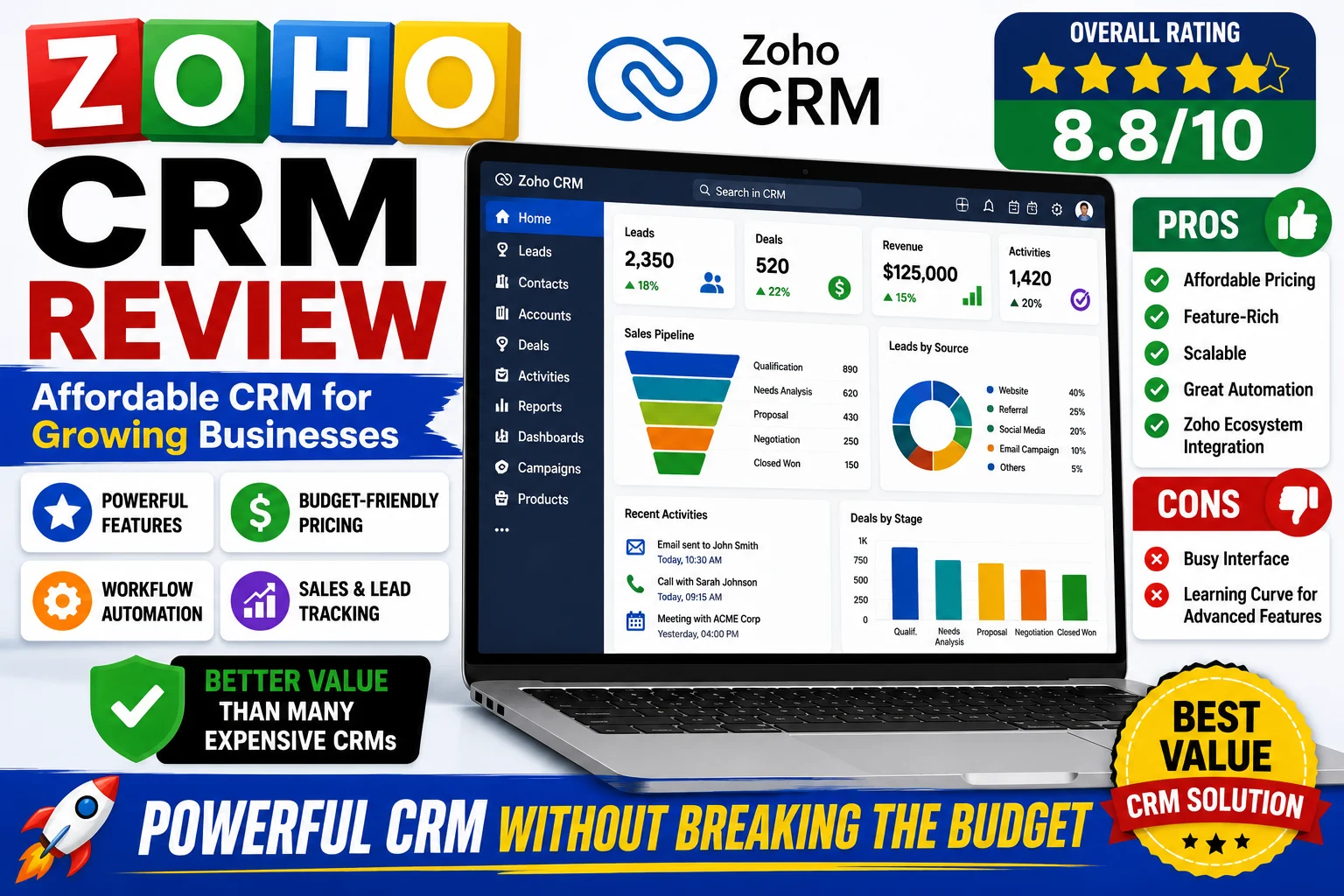
CRM software can help businesses organize customer information, improve sales processes, and strengthen customer relationships.
However, many CRM platforms become expensive as businesses grow.
This is one reason why Zoho CRM has become a popular choice among startups, small businesses, and budget-conscious organizations.
Zoho CRM is known for offering a wide range of features at competitive pricing while remaining flexible enough to support growing businesses.
But is Zoho CRM the right solution for your company?
In this review, we’ll explore Zoho CRM’s features, pricing, strengths, weaknesses, and ideal use cases to help you decide.
What Is Zoho CRM?
Zoho CRM is a cloud-based customer relationship management platform designed to help businesses manage:
- Leads
- Contacts
- Sales opportunities
- Marketing activities
- Customer interactions
It is part of the larger Zoho ecosystem, which includes dozens of business applications covering accounting, email, project management, customer support, and more.
Because of this ecosystem, Zoho CRM can serve as a central hub for business operations.
Quick Overview
| Category | Rating |
|---|---|
| Features | 9/10 |
| Pricing | 9.5/10 |
| Ease of Use | 8/10 |
| Automation | 8.5/10 |
| Reporting | 8.5/10 |
| Scalability | 9/10 |
| Overall Rating | 8.8/10 |
Key Features of Zoho CRM
Zoho CRM provides a strong collection of tools suitable for businesses of various sizes.
Contact Management
Zoho CRM allows businesses to organize customer information in one centralized database.
Contact records can include:
- Names
- Email addresses
- Phone numbers
- Company information
- Communication history
- Notes
This helps teams maintain a complete view of customer interactions.
Lead Management
Lead management is one of Zoho CRM’s strongest areas.
Businesses can:
- Capture leads
- Assign leads automatically
- Track lead activity
- Score leads
This helps sales teams focus on high-priority opportunities.
Sales Pipeline Management
Zoho CRM offers visual sales pipelines that help users monitor opportunities throughout the sales cycle.
Benefits include:
- Better visibility
- Improved forecasting
- Organized deal tracking
Users can customize pipeline stages to match their sales processes.
Workflow Automation
Automation helps businesses reduce repetitive tasks.
Zoho CRM can automate:
- Lead assignments
- Follow-up reminders
- Email notifications
- Task creation
- Workflow approvals
Automation improves efficiency and consistency.
Reporting and Analytics
Zoho CRM includes reporting tools that help businesses analyze performance.
Users can generate reports related to:
- Sales performance
- Conversion rates
- Lead sources
- Revenue forecasting
Managers gain valuable insights for decision-making.
Multichannel Communication
Zoho CRM supports communication through:
- Phone
- Social media
- Live chat
This allows businesses to interact with customers across multiple channels.
User Experience
Zoho CRM offers a good balance between simplicity and functionality.
New users may need some time to learn the platform, but the interface is generally intuitive.
Compared to enterprise-focused CRM platforms, Zoho CRM is easier to adopt and implement.
Businesses moving from spreadsheets often find the transition manageable.
Zoho CRM Pricing
Pricing is one of Zoho CRM’s biggest advantages.
Free Plan
Zoho CRM offers a free plan for small teams.
The free version includes:
- Basic contact management
- Lead management
- Sales tracking
This is useful for startups and freelancers.
Standard Plan
Suitable for small businesses that need:
- Workflow automation
- Reporting tools
- Additional customization
Professional Plan
Includes:
- Advanced automation
- Inventory management
- Sales forecasting
- Enhanced analytics
Enterprise Plan
Designed for larger organizations requiring:
- Advanced customization
- Role management
- AI-powered insights
- Enterprise-level features
Pros of Zoho CRM
Affordable Pricing
Zoho CRM delivers strong value compared to many competitors.
This makes it attractive for budget-conscious businesses.
Feature-Rich Platform
Despite its lower cost, Zoho CRM includes many advanced capabilities.
Strong Automation
Workflow automation helps teams improve productivity.
Excellent Scalability
Businesses can start small and upgrade as their requirements grow.
Zoho Ecosystem Integration
Users can connect Zoho CRM with other Zoho applications for a more unified business environment.
Cons of Zoho CRM
Interface Can Feel Busy
Some users find the dashboard less polished than certain competitors.
Learning Curve for Advanced Features
Basic functions are easy to learn, but advanced customization may require additional training.
Customer Support Experience Varies
Support quality may differ depending on plan level and region.
Who Should Use Zoho CRM?
Zoho CRM is an excellent fit for:
Small Businesses
Businesses looking for affordable CRM software.
Startups
Organizations needing scalable customer management tools without high costs.
Growing Sales Teams
Companies seeking automation and lead management capabilities.
Existing Zoho Users
Businesses already using Zoho products benefit from seamless integration.
Who Might Need an Alternative?
Zoho CRM may not be ideal for:
Large Enterprise Organizations
Some enterprises require deeper customization and advanced functionality.
Businesses Seeking Maximum Simplicity
Certain CRM platforms offer more beginner-friendly experiences.
Organizations Requiring Extensive Third-Party Integrations
While Zoho integrates with many tools, some competitors have larger integration ecosystems.
Zoho CRM vs HubSpot CRM
This is one of the most common CRM comparisons.
Zoho CRM Advantages
- Lower pricing
- More features in lower-tier plans
- Better value for budget-conscious businesses
HubSpot Advantages
- Easier user experience
- Better free plan experience
- Faster onboarding
Zoho CRM vs Salesforce
Zoho CRM
- More affordable
- Easier implementation
- Better for small businesses
Salesforce
- Greater customization
- Stronger enterprise capabilities
- More advanced reporting
Real-World Example
Imagine a growing marketing agency with a limited budget.
The business needs:
- Lead tracking
- Sales automation
- Reporting
- Contact management
Zoho CRM can provide these capabilities without requiring the larger investment associated with some enterprise CRM platforms.
For many growing businesses, this balance of features and affordability is highly attractive.
Is Zoho CRM Worth It?
For many startups and small businesses, the answer is yes.
Zoho CRM provides:
- Strong functionality
- Competitive pricing
- Automation capabilities
- Scalability
at a lower cost than many major competitors.
Businesses that prioritize value often find Zoho CRM difficult to ignore.
Final Verdict
Overall Rating: 8.8/10 ⭐
Zoho CRM is one of the best budget-friendly CRM solutions available today.
Its combination of affordability, flexibility, automation, and scalability makes it an excellent choice for startups, small businesses, and growing organizations.
While it may not offer the same enterprise-level depth as Salesforce or the same polished user experience as HubSpot, Zoho CRM delivers outstanding value for the price.
If you’re looking for a feature-rich CRM without a premium price tag, Zoho CRM deserves serious consideration.
Frequently Asked Questions
Is Zoho CRM free?
Yes. Zoho CRM offers a free plan with basic CRM functionality for small teams.
Is Zoho CRM good for small businesses?
Yes. Its affordability and feature set make it one of the most popular CRM choices for small businesses.
What is Zoho CRM best known for?
Zoho CRM is known for providing strong CRM features at competitive pricing.
Is Zoho CRM better than HubSpot?
It depends on priorities. Zoho often provides better value, while HubSpot is generally easier to use.
Is Zoho CRM worth the money?
For many startups and small businesses, Zoho CRM offers excellent value compared to higher-priced competitors.