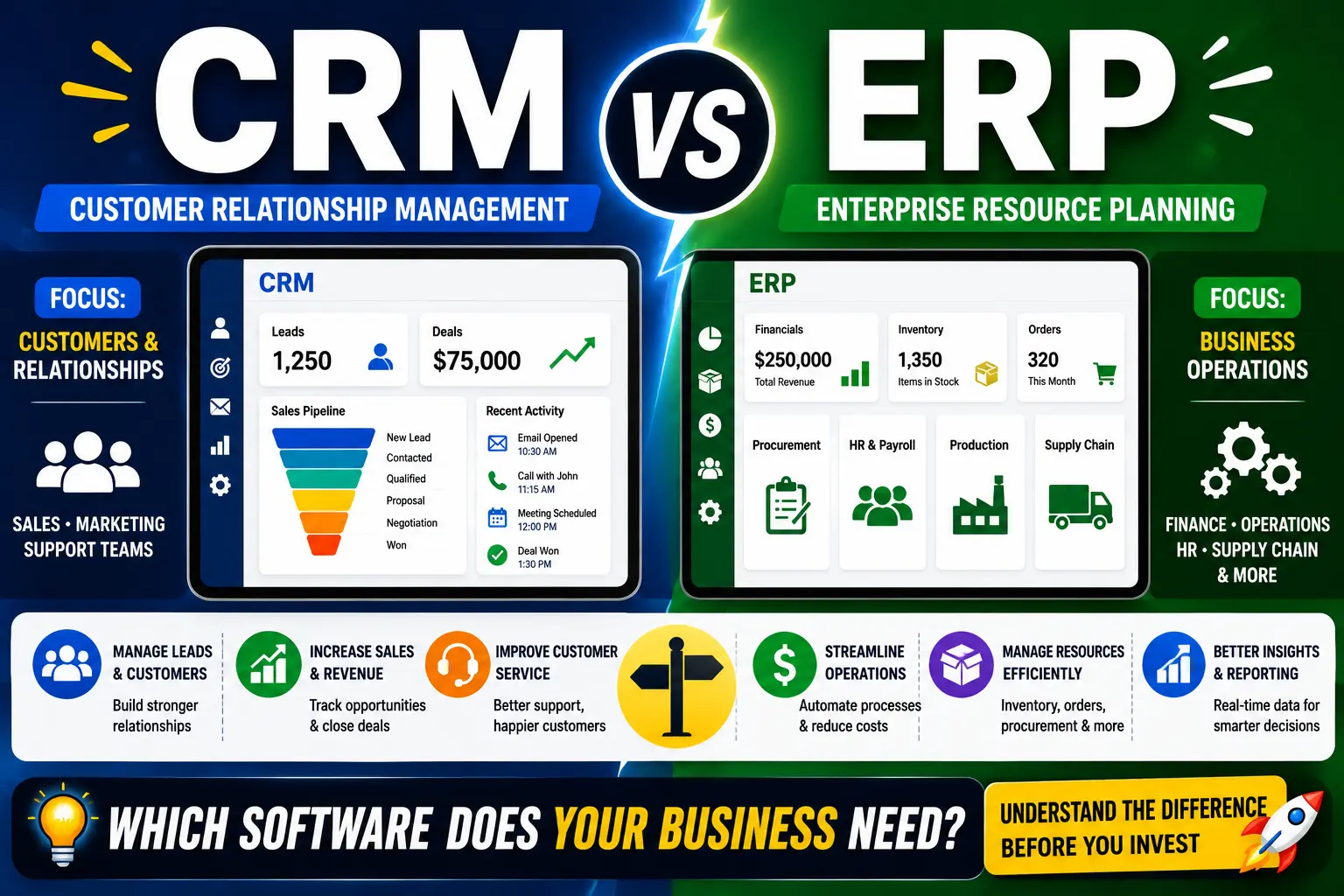
Businesses today rely on software to manage customers, streamline operations, and improve productivity.
Two of the most commonly discussed business systems are CRM (Customer Relationship Management) and ERP (Enterprise Resource Planning) software.
Many business owners, especially those evaluating software for the first time, often wonder:
Do I need a CRM, an ERP, or both?
While CRM and ERP systems may appear similar, they serve very different purposes.
Understanding their differences will help you make better technology decisions and invest in software that supports your business goals.
In this guide, we’ll break down CRM vs ERP in simple terms, explain their features, benefits, and help you determine which solution is right for your organization.
What Is CRM?
CRM stands for Customer Relationship Management.
CRM software focuses on managing customer interactions and sales activities.
Its primary purpose is to help businesses:
- Manage leads
- Track sales opportunities
- Improve customer relationships
- Increase customer retention
- Organize customer information
CRM systems are mainly used by:
- Sales teams
- Marketing teams
- Customer support teams
Popular CRM platforms include:
- HubSpot CRM
- Salesforce CRM
- Zoho CRM
- Pipedrive
- Freshsales
What Is ERP?
ERP stands for Enterprise Resource Planning.
ERP software focuses on managing internal business operations.
An ERP system integrates various departments into a single platform.
It often includes:
- Accounting
- Finance
- Inventory management
- Procurement
- Human resources
- Manufacturing
- Supply chain management
ERP systems help businesses improve operational efficiency and data accuracy.
Popular ERP solutions include:
- SAP ERP
- Oracle ERP
- Microsoft Dynamics 365
- NetSuite
- Odoo ERP
The Simplest Way to Understand CRM vs ERP
A simple explanation is:
CRM = Customer-Facing Activities
CRM helps businesses attract, manage, and retain customers.
ERP = Internal Operations
ERP helps businesses manage resources, processes, and operations behind the scenes.
CRM vs ERP: Core Differences
| Feature | CRM | ERP |
|---|---|---|
| Primary Focus | Customers | Business Operations |
| Main Users | Sales & Marketing Teams | Finance, Operations & Management |
| Goal | Increase Revenue | Improve Efficiency |
| Data Managed | Customer Data | Business Process Data |
| Lead Tracking | Yes | No |
| Sales Pipeline | Yes | Limited |
| Inventory Management | No | Yes |
| Accounting | Limited | Yes |
| Human Resources | No | Yes |
| Procurement | No | Yes |
CRM Features
CRM software focuses heavily on customer-related processes.
Common CRM features include:
Contact Management
Store customer details in one place.
Lead Management
Track potential customers through the sales process.
Sales Pipeline Management
Monitor opportunities and deal progress.
Email Tracking
Manage customer communication.
Marketing Automation
Automate campaigns and lead nurturing.
Customer Support Tracking
Improve service quality and response times.
ERP Features
ERP software manages broader business operations.
Common ERP features include:
Financial Management
Track budgets, revenue, expenses, and accounting activities.
Inventory Management
Monitor stock levels and product movement.
Procurement Management
Manage purchasing processes.
Human Resources
Handle employee records and payroll.
Supply Chain Management
Coordinate suppliers, inventory, and logistics.
Manufacturing Management
Monitor production workflows.
Benefits of CRM Software
CRM systems provide several advantages.
Improved Customer Relationships
Businesses gain a complete view of customer interactions.
Better Sales Performance
Sales teams can track opportunities more effectively.
Increased Customer Retention
Improved communication helps strengthen customer loyalty.
Better Marketing Results
Marketing teams can nurture leads more efficiently.
Improved Customer Service
Support teams can access customer history instantly.
Benefits of ERP Software
ERP systems offer different advantages.
Improved Efficiency
Business processes become more organized and streamlined.
Centralized Data
Departments work from the same information source.
Better Financial Visibility
Management gains accurate financial insights.
Improved Inventory Control
Businesses reduce stock shortages and overstocking.
Better Decision-Making
Real-time reporting supports strategic planning.
When Do You Need a CRM?
A CRM is often the best choice if your primary challenges involve:
- Managing customer relationships
- Tracking leads
- Increasing sales
- Improving customer service
- Organizing customer data
Businesses that focus heavily on sales and customer acquisition often benefit significantly from CRM software.
When Do You Need an ERP?
An ERP may be more suitable if your business struggles with:
- Inventory management
- Accounting processes
- Procurement
- Production planning
- Operational efficiency
ERP systems are particularly valuable for companies with complex operational requirements.
Can Businesses Use Both CRM and ERP?
Absolutely.
Many growing businesses use both systems.
CRM Manages
- Customers
- Leads
- Marketing
- Sales
ERP Manages
- Inventory
- Accounting
- Purchasing
- Operations
Together, they create a complete view of business performance.
Many modern software providers even offer integrated CRM and ERP solutions.
CRM vs ERP for Small Businesses
Most small businesses start with a CRM before implementing an ERP.
Why?
Because customer acquisition and sales growth are often the highest priorities during the early stages.
Small businesses typically need:
- Contact management
- Lead tracking
- Sales organization
before they require advanced ERP capabilities.
CRM vs ERP for Growing Companies
As businesses scale, operational complexity increases.
Growing companies often need:
- Inventory control
- Financial management
- Department coordination
At this stage, ERP software becomes increasingly valuable.
Many businesses eventually use both systems together.
Common Misconceptions
CRM and ERP Are the Same Thing
False.
While both manage business information, they focus on completely different areas.
ERP Replaces CRM
Not necessarily.
ERP systems rarely provide the same customer relationship management capabilities as dedicated CRM platforms.
Small Businesses Don’t Need ERP
Some small businesses with inventory-heavy operations may benefit from ERP software much earlier than expected.
CRM vs ERP: Which Should You Choose?
Ask yourself:
Choose CRM If:
✔ You want more leads.
✔ You want better customer relationships.
✔ You need sales pipeline management.
✔ You want marketing automation.
✔ Customer acquisition is your priority.
Choose ERP If:
✔ You need inventory management.
✔ You require advanced accounting.
✔ You manage manufacturing operations.
✔ You need supply chain visibility.
✔ Operational efficiency is your priority.
Choose Both If:
✔ Your business is growing rapidly.
✔ Multiple departments need centralized information.
✔ You want complete visibility into customers and operations.
Final Thoughts
CRM and ERP software are both powerful business tools, but they solve different problems.
CRM software helps businesses manage customer relationships, increase sales, and improve customer experiences.
ERP software helps organizations manage internal operations, financial processes, inventory, and resources.
For many small businesses, CRM is often the first step toward digital transformation.
As operations become more complex, ERP software can provide additional structure and efficiency.
The best choice depends on your business goals, challenges, and stage of growth.
Understanding the differences between CRM and ERP will help you invest in the right technology and support long-term success.
Frequently Asked Questions
What is the main difference between CRM and ERP?
CRM focuses on customer relationships and sales, while ERP focuses on business operations and resource management.
Can a company use both CRM and ERP?
Yes. Many businesses use CRM for customer management and ERP for operational management.
Which is better for small businesses?
Most small businesses benefit from CRM software first because customer acquisition and sales are usually top priorities.
Does ERP include CRM features?
Some ERP systems offer basic CRM functionality, but dedicated CRM platforms typically provide more advanced customer management tools.
Should startups use ERP software?
Most startups begin with CRM software and add ERP systems later as operational complexity increases.