One of the first questions businesses ask when searching for CRM software is:
Should I use a free CRM or invest in a paid CRM?
The good news is that many CRM providers offer free plans that can help businesses organize contacts, track leads, and manage customer relationships.
However, free CRM solutions often come with limitations that may become challenging as a business grows.
The right choice depends on your business size, goals, budget, and future requirements.
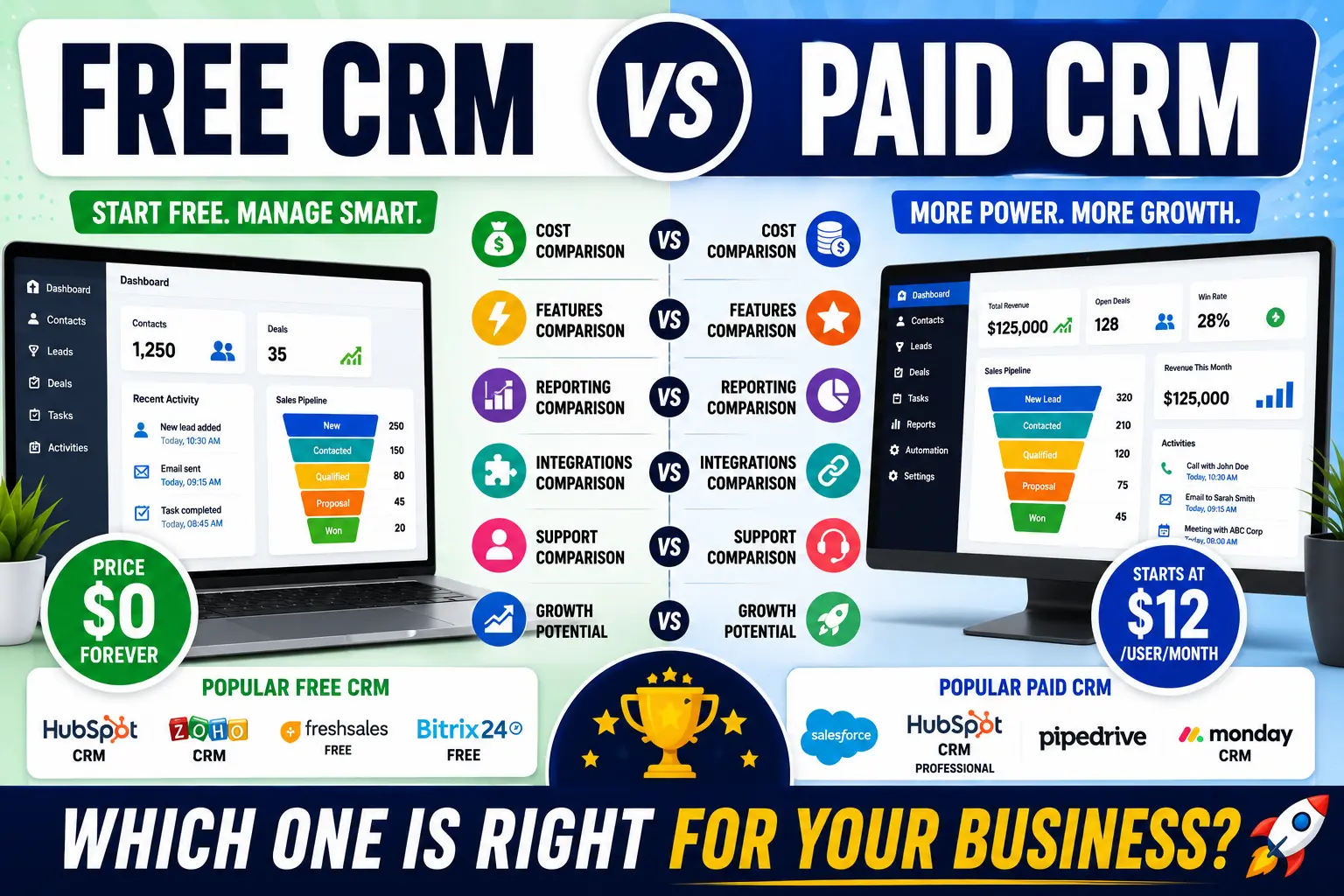
In this guide, we’ll compare free CRM and paid CRM software to help you determine which option makes the most sense for your organization.
What Is a Free CRM?
A free CRM is a customer relationship management platform that offers core CRM features at no cost.
Most free CRMs include:
- Contact management
- Lead tracking
- Basic sales pipelines
- Task management
- Activity tracking
Free plans are often designed to help businesses get started before upgrading to premium plans.
Popular free CRM options include:
- HubSpot CRM
- Zoho CRM Free
- Freshsales Free
- Bitrix24 Free
- Agile CRM Free
What Is a Paid CRM?
A paid CRM requires a monthly or annual subscription fee.
Paid plans usually provide:
- Advanced automation
- Enhanced reporting
- Custom workflows
- More integrations
- Larger user limits
- Better customer support
Businesses typically upgrade when they need features that free plans do not provide.
Free CRM Advantages
1. No Upfront Cost
The biggest advantage is obvious.
Businesses can start using CRM software without making a financial investment.
This is particularly valuable for:
- Startups
- Freelancers
- Small businesses
- Solopreneurs
2. Easy to Test CRM Software
A free CRM allows businesses to explore CRM functionality before committing to a subscription.
Teams can learn:
- CRM basics
- Lead management
- Pipeline management
- Customer tracking
without financial risk.
3. Suitable for Small Teams
Many free CRM plans provide enough functionality for businesses with:
- Limited customers
- Simple sales processes
- Small teams
Not every company requires enterprise-level features.
4. Lower Risk
Because there is no subscription fee, businesses can test different CRM platforms before selecting a long-term solution.
This flexibility can help avoid expensive mistakes.
Free CRM Limitations
While free CRM software offers many benefits, there are limitations.
1. Limited Automation
Most free plans restrict automation capabilities.
You may not have access to:
- Workflow automation
- Automated email sequences
- Lead assignment rules
- Advanced triggers
Manual work often increases as business volume grows.
2. User Restrictions
Some free CRM plans limit:
- Number of users
- Contacts
- Data storage
Growing businesses can quickly outgrow these limitations.
3. Limited Reporting
Advanced reporting tools are often locked behind paid plans.
Businesses may lack access to:
- Revenue forecasting
- Custom dashboards
- Advanced analytics
- Performance tracking
4. Fewer Integrations
Free plans typically offer fewer software integrations.
This can create inefficiencies when using multiple business tools.
5. Limited Customer Support
Many free CRM providers offer:
- Community forums
- Knowledge bases
- Self-service documentation
Priority support is usually reserved for paying customers.
Paid CRM Advantages
Paid CRM software offers significantly more functionality.
1. Advanced Automation
One of the biggest reasons businesses upgrade is automation.
Paid CRM systems often automate:
- Follow-up emails
- Lead assignments
- Workflow triggers
- Task creation
- Customer journeys
Automation saves time and improves consistency.
2. Better Reporting and Analytics
Paid plans usually provide detailed business insights.
Examples include:
- Revenue forecasting
- Conversion tracking
- Sales performance reports
- Custom dashboards
These insights help businesses make smarter decisions.
3. Greater Scalability
As businesses grow, CRM requirements become more complex.
Paid plans often support:
- Larger teams
- More contacts
- More data storage
- Advanced permissions
This scalability helps businesses grow without changing platforms.
4. More Integrations
Premium CRM plans often integrate with:
- Email marketing software
- Accounting systems
- E-commerce platforms
- Customer support tools
- Project management software
These integrations improve efficiency and reduce manual work.
5. Professional Support
Most paid CRM providers offer:
- Live chat
- Phone support
- Priority assistance
- Dedicated account managers
Access to expert support can reduce downtime and improve adoption.
Paid CRM Disadvantages
Despite their advantages, paid CRMs have drawbacks.
1. Higher Costs
Subscription fees can increase as:
- Users increase
- Features expand
- Business needs grow
Businesses should consider long-term costs carefully.
2. Learning Curve
Advanced CRM systems often contain more features.
Employees may require additional training to fully utilize the platform.
3. Paying for Unused Features
Many businesses purchase expensive plans and use only a small percentage of available functionality.
Always match features to actual business needs.
Free CRM vs Paid CRM Comparison
| Feature | Free CRM | Paid CRM |
|---|---|---|
| Cost | Free | Monthly or Annual Fee |
| Contact Management | Yes | Yes |
| Lead Tracking | Yes | Yes |
| Automation | Limited | Advanced |
| Reporting | Basic | Advanced |
| Integrations | Limited | Extensive |
| Customer Support | Basic | Priority Support |
| Scalability | Limited | High |
| Customization | Limited | Extensive |
Who Should Use a Free CRM?
A free CRM is often ideal for:
Freelancers
Managing client information without additional expenses.
Startups
Building customer management processes before scaling.
Small Businesses
Testing CRM software before upgrading.
Solopreneurs
Organizing customer relationships efficiently.
If your needs are simple, a free CRM may be all you need.
Who Should Use a Paid CRM?
A paid CRM is usually better for:
Growing Businesses
Businesses experiencing rapid growth often require advanced features.
Sales Teams
Sales organizations benefit from automation and reporting tools.
Marketing Teams
Advanced campaign tracking often requires premium plans.
Customer Support Operations
Support teams benefit from integrations and workflow automation.
Signs You’ve Outgrown a Free CRM
You may need to upgrade if:
- Manual work is increasing.
- Reporting is insufficient.
- User limits are becoming restrictive.
- Automation is required.
- Customer volume is growing.
- Integrations are limited.
These are common indicators that a business is ready for a paid solution.
Popular Free CRM Options
HubSpot CRM
Known for ease of use and generous free features.
Zoho CRM Free
Suitable for small teams and startups.
Freshsales Free
Good option for businesses exploring sales-focused CRM tools.
Bitrix24
Offers a broad set of collaboration features.
Popular Paid CRM Options
Salesforce
Highly customizable and enterprise-focused.
HubSpot Professional
Strong marketing and sales automation.
Pipedrive
Excellent pipeline management.
Monday CRM
Strong visual workflows and collaboration features.
Freshsales Premium
Advanced sales automation and reporting.
Final Thoughts
Choosing between a free CRM and a paid CRM depends on your current business needs and future goals.
For startups and small businesses, a free CRM can provide an excellent starting point with minimal risk.
However, as your customer base grows and processes become more complex, a paid CRM often becomes necessary to support automation, reporting, integrations, and scalability.
Rather than asking whether free or paid CRM is better, ask:
“Which CRM solution best supports my business today while allowing room for future growth?”
The answer to that question will guide you toward the right decision.
Frequently Asked Questions
Is a free CRM enough for a small business?
Yes. Many small businesses successfully use free CRM plans during their early growth stages.
What is the biggest advantage of a paid CRM?
Advanced automation and reporting capabilities are often the biggest benefits.
When should I upgrade from a free CRM?
Consider upgrading when you need more users, advanced automation, better reporting, or additional integrations.
What is the best free CRM?
HubSpot CRM, Zoho CRM, and Freshsales are among the most popular free CRM options.
Are paid CRMs worth the investment?
For growing businesses that rely heavily on customer management, sales tracking, and automation, paid CRMs often provide significant long-term value.