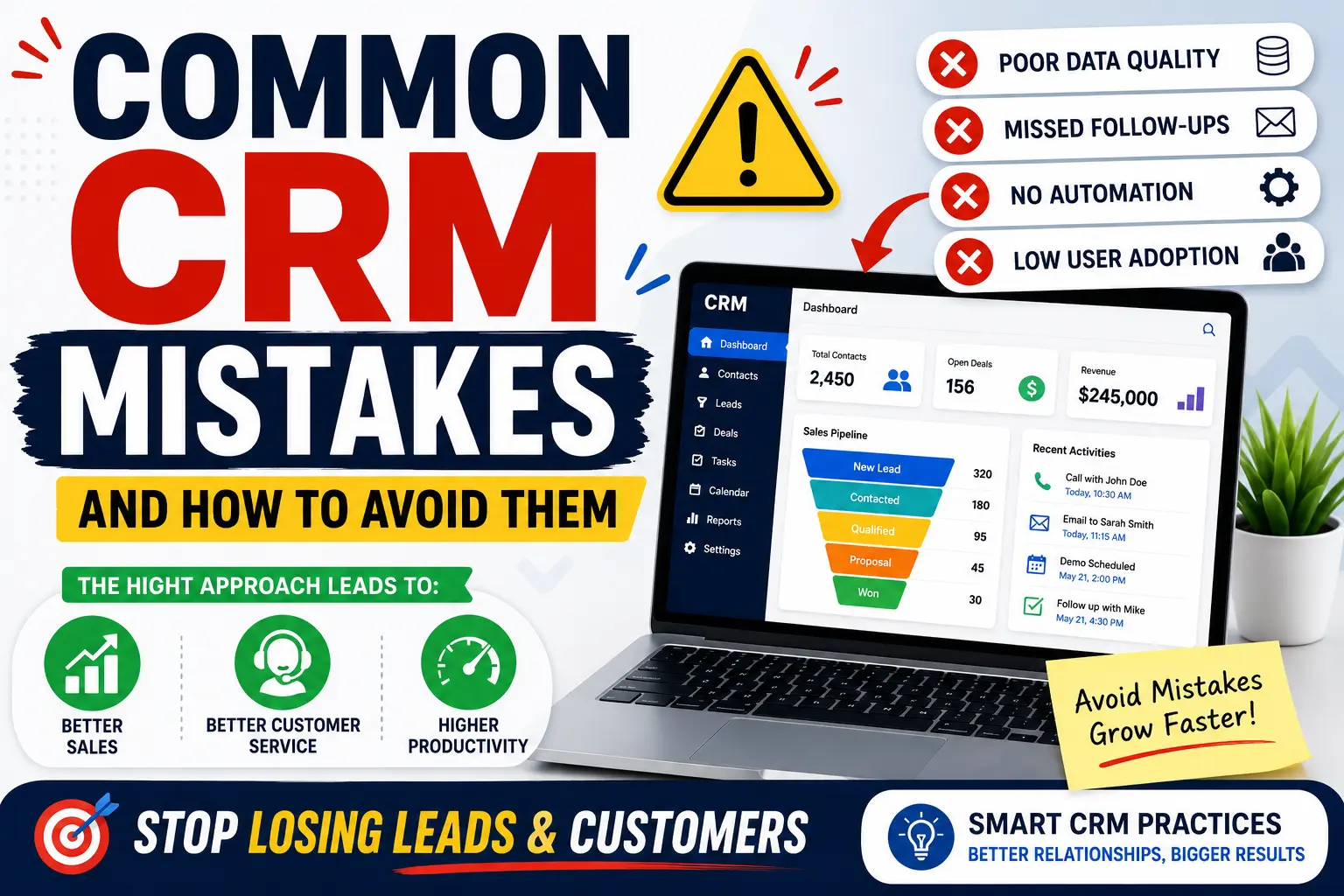
Customer Relationship Management (CRM) software can be one of the most valuable tools a business uses.
A CRM helps organize customer data, improve communication, streamline sales processes, and increase productivity. However, simply implementing a CRM does not guarantee success.
Many businesses invest in CRM software but fail to achieve the results they expected because of avoidable mistakes.
Whether you’re using a CRM for the first time or looking to improve your current system, understanding these common mistakes can help you maximize your investment and get better results.
In this guide, we’ll explore the most common CRM mistakes businesses make and how to avoid them.
Why CRM Success Depends on More Than Software
Many businesses assume that buying CRM software will automatically solve their customer management problems.
In reality, CRM software is only a tool.
Success depends on:
- Proper implementation
- Consistent usage
- Accurate data
- Employee adoption
- Clear business processes
Without these elements, even the most advanced CRM system can fail to deliver value.
Mistake #1: Choosing the Wrong CRM
One of the biggest mistakes businesses make is selecting CRM software based solely on popularity.
A CRM that works well for one company may not be suitable for another.
Why It Happens
Businesses often focus on:
- Brand reputation
- Marketing claims
- Large feature lists
Instead of evaluating their actual needs.
How to Avoid It
Before selecting a CRM, consider:
- Business size
- Industry requirements
- Team size
- Budget
- Required integrations
- Future growth plans
Choose a CRM that aligns with your specific business goals.
Mistake #2: Poor Data Quality
A CRM is only as valuable as the data stored inside it.
Incorrect or incomplete information creates problems throughout the organization.
Examples
- Duplicate contacts
- Incorrect phone numbers
- Missing email addresses
- Outdated customer records
Poor data quality can lead to missed opportunities and poor customer experiences.
How to Avoid It
Create data management rules:
- Regularly update records
- Remove duplicates
- Standardize data entry procedures
- Verify information whenever possible
Clean data improves CRM performance and reporting accuracy.
Mistake #3: Not Training Employees Properly
Many CRM implementations fail because employees don’t fully understand how to use the system.
Common Problems
- Inconsistent usage
- Missing information
- Resistance to adoption
- Incorrect data entry
How to Avoid It
Provide:
- Initial CRM training
- Ongoing education
- User guides
- Team workshops
The easier employees understand the system, the more likely they are to use it consistently.
Mistake #4: Ignoring CRM Adoption
A CRM only works if employees actually use it.
Some organizations invest heavily in software but fail to encourage team adoption.
Warning Signs
- Employees continue using spreadsheets.
- Customer information remains scattered.
- CRM records are incomplete.
How to Avoid It
Make the CRM part of daily workflows.
Encourage employees to:
- Record activities
- Update opportunities
- Log customer interactions
- Complete assigned tasks
Management should lead by example and actively use CRM reporting tools.
Mistake #5: Failing to Define a Sales Process
Many businesses implement CRM software before defining their sales process.
As a result, sales pipelines become disorganized and difficult to manage.
How to Avoid It
Clearly define:
- Lead generation
- Lead qualification
- Sales stages
- Proposal process
- Closing procedures
- Customer onboarding
A well-defined process makes CRM implementation much more effective.
Mistake #6: Not Using Automation
Modern CRM systems offer powerful automation features.
Yet many businesses continue performing repetitive tasks manually.
Tasks That Can Be Automated
- Lead assignments
- Follow-up reminders
- Welcome emails
- Status updates
- Task creation
Benefits
Automation helps:
- Save time
- Reduce errors
- Improve consistency
- Increase productivity
Businesses that fully utilize automation often achieve better results.
Mistake #7: Tracking Too Much Information
Some businesses try to collect every possible piece of customer information.
This often creates unnecessary complexity.
Problems
- Slower data entry
- Lower employee adoption
- Incomplete records
How to Avoid It
Focus on collecting information that directly supports:
- Sales activities
- Customer service
- Marketing efforts
Keep forms and customer records simple whenever possible.
Mistake #8: Ignoring Customer History
Every customer interaction provides valuable information.
Businesses that fail to record communication history often deliver inconsistent customer experiences.
Example
A customer contacts support regarding an issue.
Weeks later, they speak with a salesperson who has no knowledge of previous conversations.
This creates frustration.
How to Avoid It
Ensure all interactions are recorded inside the CRM.
This includes:
- Calls
- Emails
- Meetings
- Support requests
- Notes
A complete customer history improves communication and service quality.
Mistake #9: Not Integrating Other Business Tools
Many businesses use:
- Email marketing software
- Accounting platforms
- E-commerce systems
- Customer support tools
If these systems remain disconnected, data becomes fragmented.
How to Avoid It
Integrate your CRM with essential business applications.
Benefits include:
- Improved efficiency
- Reduced manual entry
- Better reporting
- More accurate customer profiles
Mistake #10: Ignoring CRM Reports
CRM systems generate valuable insights, but many businesses rarely review reports.
Missed Opportunities
Without reporting, businesses may fail to identify:
- Weak sales performance
- Declining conversion rates
- Poor lead sources
- Customer retention issues
How to Avoid It
Review CRM reports regularly.
Track metrics such as:
- Lead conversion rate
- Revenue growth
- Customer acquisition cost
- Sales pipeline health
Data-driven decisions often produce better outcomes.
Mistake #11: Lack of Follow-Up Discipline
Many sales opportunities are lost because businesses fail to follow up consistently.
Research consistently shows that multiple touchpoints are often required before a prospect makes a purchase decision.
How to Avoid It
Use CRM reminders and task management features to schedule:
- Calls
- Emails
- Meetings
- Follow-up sequences
Consistency is one of the biggest drivers of sales success.
Mistake #12: Treating CRM as a One-Time Project
Some companies view CRM implementation as a task that ends once the software is installed.
In reality, CRM optimization is an ongoing process.
How to Avoid It
Regularly review:
- Workflows
- Automations
- Reports
- User feedback
- Business goals
Continuous improvement helps maximize CRM value over time.
Signs Your CRM Strategy Needs Improvement
You may need to improve your CRM processes if:
- Customer information is incomplete.
- Team members avoid using the CRM.
- Sales opportunities are frequently missed.
- Reports are inaccurate.
- Follow-ups are inconsistent.
- Customer service quality is declining.
Recognizing these warning signs early can prevent larger problems.
CRM Best Practices for Long-Term Success
To maximize CRM performance:
Keep Data Clean
Maintain accurate customer records.
Train Employees Regularly
Ensure everyone understands how to use the system.
Automate Repetitive Tasks
Save time and improve consistency.
Review Reports Frequently
Use data to guide decisions.
Focus on Customer Experience
Every CRM activity should support stronger customer relationships.
Continuously Improve Processes
CRM success requires ongoing optimization.
Final Thoughts
CRM software can transform the way businesses manage customer relationships, but only when used correctly.
Many CRM failures result not from poor software but from poor implementation, inconsistent usage, and avoidable mistakes.
By selecting the right CRM, maintaining clean data, encouraging user adoption, leveraging automation, and continuously improving processes, businesses can unlock the full potential of their CRM system.
Avoiding these common mistakes will help your organization improve customer relationships, increase sales efficiency, and achieve better long-term results.
Frequently Asked Questions
What is the most common CRM mistake?
Poor data quality is one of the most common CRM mistakes because inaccurate information affects every aspect of customer management.
Why do CRM implementations fail?
CRM projects often fail due to poor planning, inadequate training, lack of user adoption, and unclear business processes.
How can businesses improve CRM adoption?
Providing proper training, simplifying workflows, and integrating CRM into daily operations can significantly improve adoption.
Should small businesses use CRM automation?
Yes. Automation helps small businesses save time, improve consistency, and reduce manual work.
How often should CRM data be reviewed?
Businesses should review and clean CRM data regularly, ideally on a monthly basis, to maintain accuracy and effectiveness.